Simon Bridges asked to put aside politics on plastic waste
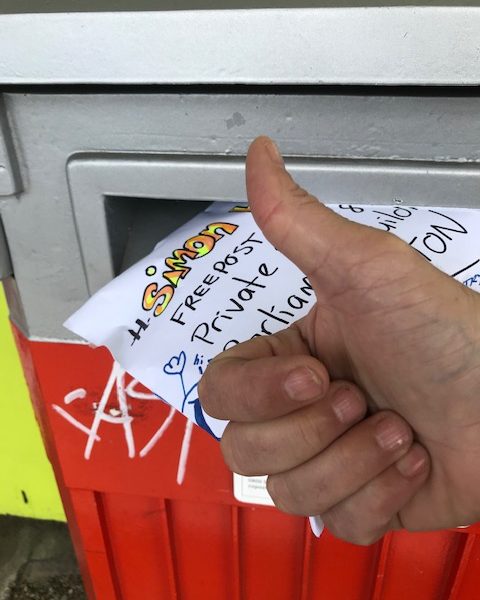
This week the plastic2parliament initiative mailed well over 130 plastic-stuffed letters to National Party leader Simon Bridges asking him to “do something crazy” and put aside party politics on plastic waste.
The letters asked him to support the Product Stewardship changes to the Waste Minimisation Act 2008 (WMA) proposed by the Government including plastic packaging.
“A massive opportunity to get on top of New Zealand’s plastic waste problem was lost during the 9 years of a National Government where they essentially sat on the powers contained in the WMA and did absolutely nothing to deploy them. Now Simon Bridges can act constructively to support the Government’s proposed changes and announce a meaningful plastic reduction policy of his own as well.” said Wade Bishop, the initiator of the letter writing to MPs.
Plastic2parliament is encouraging citizens concerned about the growing epidemic of avoidable and single-use packaging plastics to engage in penning letters to MPs in Parliament via the Parliamentary Freepost address. Citizens are also being asked to stuff their large envelopes full of non-recyclable plastics.
“I see this as a creative way to physically take this unfettered, over-production of single-use plastics directly to the desks of MPs where they can’t ignore it.” said Mr. Bishop.
“MPs need to acknowledge that plastic waste is a production problem, not a consumer issue, and advocate for meaningful plastic reduction policies (within their respective political Party) and to regulate the producers of these plastic products,” he said.
The plastic2parliament initiative shows no sign of slowing down. Membership to the Facebook Group now growing beyond 800 people. In turn, its members have delivered more than 350 letters and parcels of non-recyclable plastics to MPs since the middle of October.
“This might seem like a frivolous thing to be doing, but we are drawing attention to very serious issues that the public and MPs need to be fully aware of,” Wade Bishop said.
“The fact is, while we already now know that plastic pollution is an astonishingly big problem, global oil companies are investing US$180 billion in new plastic manufacturing plants aiming to increase virgin plastic production by 40% before 2030.
“This is the true cause of the explosion in single-use plastics around us here in New Zealand. This clearly illustrates that it is a production issue and not a matter of consumer choice as we always seem to hear.” he said.
Plastic2parliament is advocating that waste policy and legislation focus on the source of single-use plastics by regulating the producers of them to reduce volumes of plastic packaging entering the economy and then the environment.
“Setting measurable reduction targets on the import of virgin plastic resins, used for packaging, and, on import volumes of new plastic packaging, would be one clear way of measuring the success of any regulations that are put in place.” Mr. Bishop said.
“Only about 20% of plastics are recycled each year and many are not even recyclable for various reasons. With plastic production set to increase 40 percent in the coming 10 years, recycling is clearly not the solution to the plastic waste problem. The best solution is making less in the first place.” he said.
ENDS
Expat Brit Makes Extra $280,000 on Pension by Transferring to New Zealand
The on-going Brexit negotiations and subsequent demise of the UK exchange rate have left many British expatriots who have moved to New Zealand wondering what to do about their UK pensions.
Should they wait for a more favourable exchange rate, or bite the bullet and transfer their pensions now – knowing that it could get far worse before it improves?
Alison Renfrew, pension transfer specialist at Lyford Investment Management, has been advising British expatriots for 17 years on their options for transferring their pensions. She recommends that with some exceptions, transferring now is probably the better option.
Why?
“Firstly, if you’re worried about the exchange rate, you can keep your funds invested in GBP and convert them into NZD years in the future,” says Renfrew.
“More importantly though; pension transfer values seem to be really high at the moment.
“I advised a client earlier this month that her transfer value had increased by 25% in just six months. She now has another £145,168 ($281,776NZD) to transfer. This is phenomenal”.
Renfrew has not seen such a dramatic positive change in transfer values before.
On the very same day, Renfrew had a conversation with another client about her pension transfer value. She was offered a Cash Equivalent Transfer Value (CETV) of £59,731, or a pension of £900 p.a.
You would have to receive £900 p.a. for 66 years before you broke even – before you saw any investment returns from your retirement savings.
“It is 100% illogical to accept such a lousy deal,” Renfrew says.
When Renfrew compared current CETVs with promised pensions, she found little incentive to choose to have a taxable pension paid from the UK compared to receiving a far higher non-taxable income in New Zealand based on realistic investment projections.
“What Brits really don’t like is knowing that if they die prematurely their spouse will only get half of the income. In some cases, the spouse gets nothing”.
A major benefit of taking control and investing your transfer value to provide you with a retirement income is that you can access your money if you need to. Conversely, there’s no access to your retirement pot if you’ve elected to take a pension.
“Where is your financial security if you can’t access your money in an emergency?” Renfrew asks.
There are a couple of exceptions, of course.
Renfrew cautions Brits and returning Kiwis not to transfer their pension funds if they are uncertain where they’ll live for the five years after they have transferred their pension funds to NZ, due to tax obligations.
Renfrew further cautions that before deciding to transfer you need professional advice to ensure that all your options have been considered.
“Maybe you are one of the few who have a very attractive pension, and converting to cash would be madness.
“You really need to seek independent advice from a New Zealand investment adviser specialising in pension transfers before making the decision to transfer, because individuals simply don’t have access to the same resources advisers do. It’s important to make informed choices.”
Alison and Richard Renfrew of Lyfords have been specialising in UK to New Zealand pension transfers for over 17 years. Visit their website to find out more.
South Waikato District Council’s LED Lighting Upgrade Ready to Improve Public Safety and Air Quality
A smart LED lighting project for South Waikato District Council (SWDC) will be featured by Auckland business NB SmartCities at the IoT half-day conference on Thursday 3 October in Auckland.
The second annual IoT Conference event, hosted by the New Zealand IoT Alliance, will showcase how Internet of Things (IoT) applications are creating smart cities in New Zealand and improving industrial productivity.
IoT Alliance Executive Council member John McDermott says the project for South Waikato District Council demonstrates how IoT technology provides multiple benefits for councils and the public.
“The South Waikato District installation is a standout example of how IoT solutions can provide long-lasting advantages and create new opportunities,” McDermott says.
“The new system is using less than half the power of the legacy street lamps and is providing better lighting for many more local roads. Also important for the council is that maintenance calls have more than halved, underlining the reliability and lower maintenance costs of the new technology.”
The system, which uses open network standard technology, can also support future applications such as air pollution monitoring, traffic analysis, smart parking, and remote water metering.
“South Waikato District Council has received very positive feedback from our community on this improved street lighting,” says Ted Anderson, SWDC’s Group Manager Assets.
“Tangible benefits include people being able to exercise and participate in other outdoor activities, like walking the dog, much later in the evenings especially during winter; and the safety improvements have been highlighted by many of our residents.”
In addition to the SWDC case study, McDermott says the IoT Half-Day conference event will showcase a variety of IoT solutions focused on Smart City and Industrial use cases. “The conference is featuring applications that help deliver better public services, improve health and safety, and enhance manufacturing performance”.
Spark is the gold sponsor for the IoT Conference and Spark Future of Connectivity Lead Renee Mateparae says the company is thrilled to be sponsoring an event that will bring the tangible benefits of IoT to the forefront so businesses can realise what it could do for them.
“The benefits that new Internet of Things technologies deliver are compelling when implemented correctly. They deliver better services, greater value and improve efficiency. Spark is pleased to support the New Zealand IoT Alliance in connecting the people and businesses that are implementing and deploying IoT applications with the decision makers and leaders that need to understand the impact and value that can be achieved”.
Also speaking at the event is Melissa Lee, National MP for Mount Albert, and National spokesperson for Broadcasting, Communications and Digital Media & Ethnic Communities
The event is supported by gold sponsor Spark and silver sponsor LEAP Australia.
The IoT Half Day Conference is taking place at 12 Madden St, Viaduct, Auckland from 8.30am on Thursday 3 October. For more information and tickets, visit the NZ IoT Alliance website.
World cup for rural connectivity
Saturday’s Rugby World Cup experience shows that New Zealand deserves a Broadband World Cup for getting broadband to its rural communities.
That’s the view of WISPA.NZ, the industry group supporting 28 Wireless Internet Service Providers who collectively provide broadband to an estimated 70,000 mostly rural customers.
“The great news is that WISPs dealt with the surge in traffic almost faultlessly,” WISPA Chairman Mike Smith said. “The problems were with the international link, and with some customer devices. But the part in between worked to perfection.
“WISPs can claim a lot of credit for bringing rural Kiwis in from the broadband boondocks. Tens of thousands of rural homes and businesses now have broadband at city speeds and city prices, with the number increasing daily.
“That’s something we wouldn’t have dreamed of a decade ago. Rural communities in New Zealand have far better broadband than most other Rugby World Cup countries, notably Australia.
“WISPs are committed to finishing the job, with government support, so every rural home and business can enjoy the benefits for social inclusion, entertainment and business. Connectivity to 100% of the community is within our sights.”
ENDS
—————————————————————————————————————————————
BACKGROUND NOTES
· – Most WISPs, or regional telecommunications companies, are locally owned businesses founded in the early 2000s.
· – Initially they used their own capital, but in recent times 17 of them have received government funding through the Rural Broadband Initiative to expand their networks into remote areas that would otherwise be uneconomic.
· – About half WISP connections use “WISP Wireless” – a series of hilltop towers with radios that bounce the Internet signal from one to another, then down to the homes below. The other half are re-sold services from other telcos.
· – WISP wireless requires line of sight visibility. Hence it requires many more towers than cellular services, but these are much lower cost.
TPC Labour campaign targets light rail and water
Two massive issues the People’s Choice-Labour campaign intends to focus on for the 2019 local body elections are water quality and transport, People’s Choice chair Keir Leslie said today.
The People’s Choice-Labour campaign launch on August 31 heard plans for light rail and People’s Choice Candidates also made water a priority issue.
“The People’s Choice campaign is totally committed to pushing light rail,” said Mr Leslie.
“To future proof Christchurch for climate change it is necessary to go back and look at the options of a light rail network.
”We need light rail from Hornby to Riccarton running into the central city. Light rail also needs to extend to Papanui and the trains need to be integrated with bus services.
”Long term this network needs to extend down Colombo St to Cashmere and also take in important hubs such as the University and Linwood.
”A light rail system may not happen immediately but Christchurch needs to start planning and preparing now,” said Mr Leslie.
The People’s Choice campaign launch also served as an opportunity for People’s Choice Environment Canterbury candidate Jenny Hughes to highlight that water quality is a top priority for all the People’s Choice Environment Canterbury candidates.
”The People’s Choice candidates are offering a group of strong candidates dedicated to saving our water and upholding democracy – a task which no independent candidates can promise,” Jenny Hughes said.
For copies of the speeches, or photographs from the People’s Choice campaign launch please feel free to contact:
The People’s Choice chair, Keir Leslie – (027) 309 3322
Media Advisor, Kevin List – (021) 426 902
Authorised by Jake McLellan 6 Braddon St, Addington.
PM backs youth and diversity in Christchurch local govt campaign
Peoples Choice-Labour campaign launch, Oxford Terrace Baptist Church, 288 Oxford Terrace Christchurch, 1:00pm 31 August 2019.
The Prime Minister Jacinda Ardern is backing diversity and youth with the People’s Choice-Labour Local Government campaign, People’s Choice chair Keir Leslie said today.
Prime Minister Jacinda Ardern today released a short video backing the People’s Choice-Labour local government campaign. The Prime Minister highlighted the fact that the Christchurch People’s Choice Labour campaign involves two under 30 candidates standing for Christchurch City Council seats. Jake Mclellan (27) is standing for the Christchurch central seat while Zahra Hussaini (28) is standing for the Waimari Council seat.
“The People’s Choice-Labour campaign not only has a wide range of candidates from diverse backgrounds but is also backing younger candidates,” said Mr Leslie.
“We have two candidates under 30 standing for winnable city council seats.
“Jake McLellan has already served three years on a community board and brings a passion for local Government and a desire to tackle the big issues such as climate change, social inequity and water issues.
“Zahra Hussaini is another great candidate. Ms Hussaini is a Muslim, a Farsi interpreter, and has a huge interest in tackling ecological and climate change issues.
“Ms Hussaini is both committed to bringing Christchurch’s diverse communities together to facilitate positive change and also looking at ways to future proof our city for the challenges faced by a changing climate.
“We believe that The People’s Choice and Labour 2019 Local Government campaign is the most -diverse and inclusive local body campaign in New Zealand history,” Mr Leslie said.
“Gathered in the heart of Christchurch on the last day of August are candidates that represent many different faiths and ethnic backgrounds but with one common purpose. That purpose is bringing Christchurch together.
“Our candidates are committed to working together for the good of the people of Christchurch. O ur priorities are clean water, tackling climate change and keeping the city’s assets in public ownership.”
For more information:
Keir Leslie, Peoples Choice Labour Chair – (027) 309 3322
Kevin List, Media advisor – (021) 426 902
Jake McLellan – (027) 844 0296
Zahra Hussaini – (021) 118 4042
Authorised by Jake McLellan, 6 Braddon St, Addington, Christchurch.
ENDS
TPC-Labour Local Government Campaign Launch – Media Advisory
What: The launch of The People’s Choice – Labour Christchurch local government campaign.
Who: More than 30 Christchurch TPC-Labour Community Board, Environment Canterbury and Christchurch City Council candidates will be gathered together to kick-start the most diverse local government campaign in New Zealand’s history.
When: Saturday, August 31, 1:00pm.
Where: Oxford Terrace Baptist Church, 288 Oxford Terrace, Christchurch Central City, Christchurch.
“We believe that The People’s Choice and Labour 2019 Local Government campaign is the most -diverse and inclusive local body campaign in New Zealand history,” says Keir Leslie, The Peoples Choice Labour chair.
“Gathered in the heart of Christchurch on the last day of August are candidates that represent many different faiths and ethnic backgrounds but with one common purpose. That purpose is bringing Christchurch together.
“Our candidates are committed to working together for the good of the people of Christchurch.
“Our priorities are clean water, tackling climate change and keeping the city’s assets in public ownership.”
For more information or to speak with any of our candidates prior or post the TPC campaign launch:
Kevin List – Media advisor (021) 426 902
ENDS